

Socra UX Audit: A Broken Login and Dead-End Suggestions
This is a short, self-directed teardown of Socra — a publicly available product we picked ourselves, not a commissioned client audit.
Socra is a web AI “Socratic” learning and thinking-partner tool, built around chat-based modes such as Idea Shaper, the Feynman Technique, and Whys.
This teardown was scoped by Onix as a “Growth UX Audit,” built around a line from the report itself: “Socra has an AI learning proposition, but the current experience introduces friction at two critical moments: accessing the product and continuing the AI interaction. Broken authentication and non-functional follow-up suggestions can make the experience feel unreliable and prevent users from fully engaging with Socra’s core value.” Two findings follow below, in the report’s own order.
Problem 01
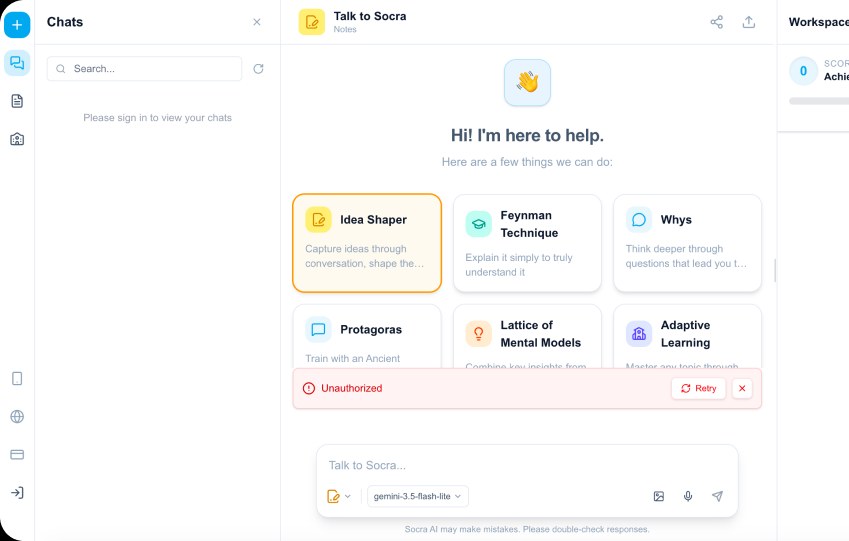
The authentication flow is inconsistent. Clicking Login opens the product, but the user remains unauthenticated. Sending a message triggers another login modal, whose Go to Login CTA leads to a Page Not Found screen. The only workaround is to exit and log in again.
Why it matters
Authentication is the first critical step before the user can experience the product’s value. When the system gives conflicting signals about the user’s login state and then leads to a broken page, trust is lost before activation even begins.
Improvement
Synchronize authentication state between the marketing site and product. After clicking Login, users should either be clearly redirected to the login screen. Ensure every login CTA inside the product leads to a valid authentication flow.
Business impact
Fixing the authentication flow can reduce early-stage abandonment and increase the number of users who successfully reach the product’s core experience. A smoother login journey can improve activation and conversion from visitor to active user while also increasing trust in the product.
Problem 02
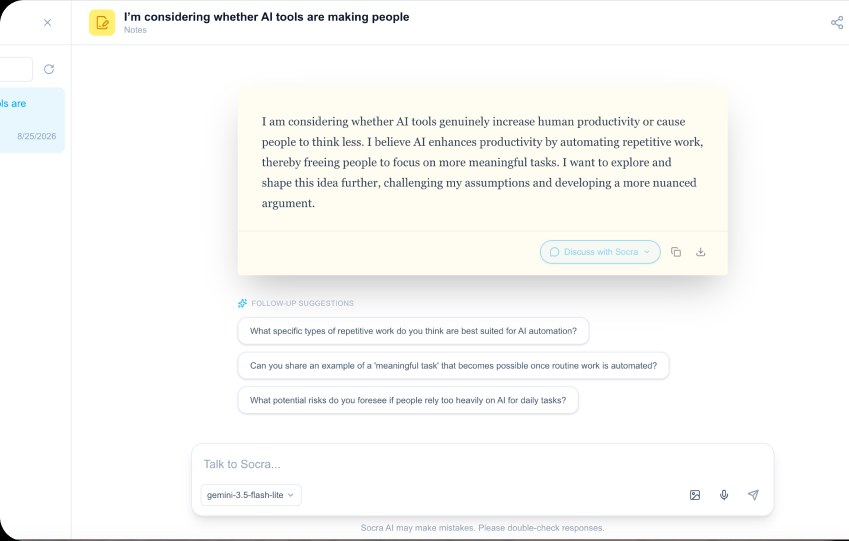
After receiving the response, Socra presents Follow-up Suggestions that look like interactive questions. However, clicking them produces no visible response or state change.
Why it matters
These suggestions are not just secondary UI elements — they are part of Socra’s core Socratic learning loop. When an interaction that appears to be the natural next step does nothing, the user loses confidence in the system and the conversation comes to a stop.
Improvement
Make each suggestion a functional CTA that immediately sends the selected question into the conversation. Provide clear feedback after selection and update/remove the suggestion once it has been used.
Business impact
Making follow-up suggestions functional can strengthen Socra’s core engagement loop and encourage users to have longer, deeper sessions. This can increase engagement and perceived product value, while creating more opportunities for users to experience Socra’s differentiated learning approach and return to the product.
Executive summary
Socra has an AI learning proposition, but the current experience introduces friction at two critical moments: accessing the product and continuing the AI interaction. Broken authentication and non-functional follow-up suggestions can make the experience feel unreliable and prevent users from fully engaging with Socra’s core value.
Key opportunities
- Create a seamless authentication flow — Ensure users are correctly authenticated and avoid broken redirects or dead ends that interrupt the path to the first interaction.
- Strengthen the conversation loop — Make Follow-up Suggestions fully interactive so users can seamlessly continue exploring ideas and experience Socra’s Socratic learning approach.
Want this for your own product?
This is a short, self-directed teardown of a publicly available product. We picked Socra ourselves to review — we weren't hired to audit it, and it isn't a client of ours. A commissioned UX audit goes further: it's scoped to your product's own goals and flows, not just what's visible to an outside visitor.
Want the same kind of review for your own product? See our website UX audit page for what's included, or browse more examples to see other teardowns.